If you own a 10ft above-ground pool, you need a compact, reliable filter pump that handles daily circulation and debris removal without overwhelming your space. This guide highlights five suitable options, explains who each is best for, and helps you compare features like flow rate, filtration type, and safety features. Whether you’re prioritizing visibility of cartridge status, 24/7 automatic operation, or budget-friendly performance, there’s a choice here for you.
Summary table of selected products:
| Product | Best For | Key Benefit | Best For Notable Limitation |
|---|---|---|---|
| KimFilter Pro Series 1000 GPH | Budgets-conscious families | Hydroaeration for balanced pH | Cartridge access requires regular maintenance |
| KimFilter Transparent 1000 GPH | Visual readers | Transparent casing for status checks | Same 1,000 GPH capacity; visibility only adds cost |
| CYXG 330 GPH | Small inflatables | Compact, easy setup | Lower flow; best for smaller pools |
| CYXG 800 GPH | Medium-size inflatables or 10ft sets | Higher flow than 330 GPH | Cartridge replacement consistency matters |
| AGPTEK 800 GPH | Safety-focused households | GFCI safety and long cord | Not the highest flow for large debris |
KimFilter Pro Series 1000 GPH Above Ground Pool Pump

Best for: Families needing solid filtration with enhanced water balance. The 1,000 GPH capacity supports typical above-ground pools, and hydroaeration technology helps maintain pH around 7.0–7.4 for cleaner water. This model emphasizes improved clarity and dependable circulation, reducing chlorination frequency and increasing overall pool health.
Why selected: It combines robust filtration with practical safety features and a design that supports frequent use without complex maintenance. The Type A/C cartridge design captures debris while keeping water clearer. ETL safety certification and a built-in GFCI add peace of mind around kids and adults near the water.
Considerations: For larger debris loads, monitor cartridge cleanliness; performance depends on cartridge condition and routine cleaning.
KimFilter Transparent 1000 GPH Above Ground Pool Pump

Best for: Pool owners who value easy monitoring of filter status. The transparent casing makes it simple to see when the cartridge is dirty, enabling timely maintenance and avoiding filtration drop-offs.
Why selected: It maintains a strong 1,000 GPH flow and can handle pools up to roughly 6,200 gallons, keeping water circulating effectively. ETL certification and a GFCI safety feature are included to protect family safety during operation.
Considerations: Visibility is helpful, but users should still schedule routine cartridge checks to sustain optimal filtration efficiency.
CYXG Filter Pump For Above Ground Pools, 330 GPH

Best for: Small inflatable or 8–10 ft easy-set pools requiring gentle filtration and compact equipment. It helps maintain water clarity with a modest flow suitable for limited volumes.
Why selected: Its compact footprint makes it a fit for tight spaces, and it’s easy to install—just set up hoses, plug into a standard outlet, and it begins circulating. A practical choice when space and budget are the priority.
Considerations: The 330 GPH rate is best for smaller volumes; for larger 10ft pools with heavier use, a higher flow model may be better to prevent stagnation.
CYXG Pool Filter Pump 800 GPH for Above Ground Pools
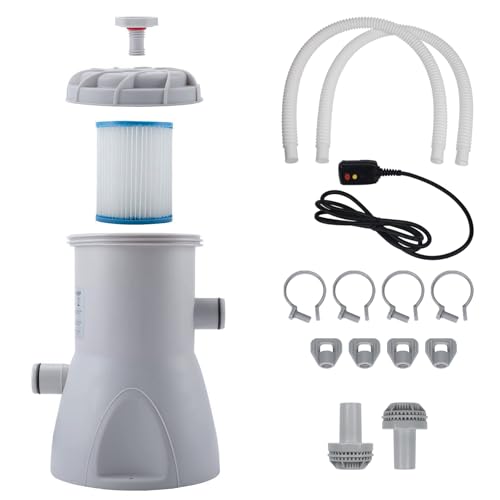
Best for: Pools up to 6,000 gallons with a higher flow than entry-level units. This model balances performance with durability and includes a Type II cartridge for more effective particle capture.
Why selected: A strong option for 10ft setups that see more use or have slightly larger water volumes. It supports easier maintenance and cleanliness without over-investing in higher-capacity equipment.
Considerations: Regular cartridge replacement improves filtration; ensure you replace cartridges as needed to sustain efficiency and water clarity.
INTEX 1,500 GPH Krystal Clear Sand Filter Pump

Best for: 10ft to slightly larger above-ground pools seeking strong continuous filtration and programmable timing. The built-in 24-hour timer supports automated operation for convenient, hands-off maintenance.
Why selected: The 1,500 GPH capacity offers robust filtration for more demanding pool use, and the 6-function valve provides flexible control (filter, backwash, rinse, re-circulate, drain, close).
Considerations: Sand filtration requires periodic backwashing and occasional sand bed maintenance to prevent channeling and reduced flow.
Buying Guide: How To Choose The Right 10ft Pool Filter Pump
- Flow Rate (GPH): For a 10ft pool, aim for 800–1,500 GPH depending on pool volume and usage. Higher flow improves circulation and debris removal but may be louder and use more power.
- Filtration Type: Cartridge filters are common, easy to maintain, and suitable for small to medium pools. Sand filters offer thorough filtration but require backwashing. Choose based on maintenance preference and availability of replacement parts.
- Safety Features: Look for ETL certification and a built-in GFCI outlet to protect against electrical faults near water.
- Visibility and Monitoring: Transparent housings can help you spot dirty cartridges early; plan for maintenance scheduling accordingly.
- Compatibility and Setup: Ensure the pump fits your pool type (inflatable vs. rigid) and has hoses and connectors compatible with your setup. A longer power cord can improve placement flexibility and safety.
- Maintenance: Check cartridge access, frequency of cleaning, and replacement interval. Some pumps include extra-long cords or tool-free assembly for quick setup.
- Safety and Durability: Corrosion-resistant materials and weatherproof design extend life in outdoor environments.
FAQ
- What is the right GPH for a 10ft pool? Aiming for 800–1,500 GPH typically balances effective circulation with energy efficiency for small to mid-sized 10ft pools.
- Do I need a GFCI on a pool pump? Yes. A GFCI helps protect users from electric shock by quickly disconnecting power if a fault is detected.
- Is a transparent pump better? Transparent views help monitor filter status, enabling timely maintenance and preventing reduced filtration efficiency.
- Cartridge vs. sand filtration? Cartridges are easier to maintain for small pools and offer good filtration; sand offers robust filtration but requires backwashing.
- How often should I replace the filter cartridge? Replacement frequency depends on pool use and water quality, but regular checks keep the system performing optimally.
- Can these pumps work with inflatable pools? Yes, many models are designed for inflatable and easy-set pools; confirm hose sizes and power requirements for your setup.