Inline chlorinators simplify pool maintenance by automatically dosing chlorine into in-ground systems. This guide highlights five top options, explains who each is best for, and explains key features to help you choose. Ideal buyers include weekend pool owners seeking straightforward setups, larger residential pools needing steady sanitation, and those upgrading from manual dosing.
Overview of selected products:
| Product | Best For | Capacity | Why It Stands Out |
|---|---|---|---|
| Hayward CL200EF In-Line Feeder | Mid- to large-sized in-ground pools | Up to 9 lb | Reliable brand; offline operation; corrosion-resistant housing |
| Pentair Rainbow 320 | Flexible, 1-3 tab setups | Small to medium tablets | Versatile tab options; easy refill |
| CRESTWAVE 320 Inline Feeder | In-ground and above-ground pools | Up to 11 large or 98 small tablets | Wide compatibility; robust flow control |
| SeaSlep Off-Line Chlorinator | Medium to large pools seeking adjustable output | 9 lb | 360° control knob; straightforward installation |
| MAYGO CL200 Inline Chlorinator | Above-ground and in-ground pools | 9 lb | 360° control for flow; clear directional guidance |
Hayward CL200EF In-Line Automatic Chlorine Feeder

The Hayward CL200EF is a compact, offline chlorine feeder designed for in-ground pools. It accepts up to 9 pounds of chlorine tablets, supporting longer intervals between refills. The unit uses a durable, corrosion-resistant housing suitable for typical pool environments. Best for owners seeking a trusted-brand feeder with straightforward, low-maintenance operation. A potential limitation is the offline design, which may require manual tablet replenishment more often than fully integrated systems.
Pentair Rainbow Model 320 Tablet Feeder

The Rainbow 320 is a versatile inline feeder supporting 1 or 3 tablet configurations. It’s suitable for varied pool sizes and chlorine needs, providing straightforward dosing in a compact format. Best for budget-conscious buyers who want a simple, replaceable tablet feeder with flexible tablet options. A potential drawback is its limited capacity per refill compared with high-capacity models.
CRESTWAVE 320 Automatic In-Line Feeder
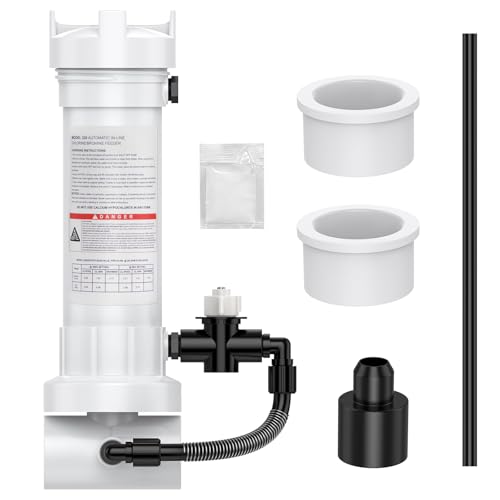
The CRESTWAVE 320 inline feeder is designed for both in-ground and above-ground pools and spas, with a high-capacity design holding up to 11 large tablets or 98 small tablets. It includes a robust flow-control valve and widened gaskets to minimize leaks. Best for multi-pool setups or larger residential systems needing strong, consistent dosing. It’s important to ensure compatibility with existing return lines to avoid niche fit issues.
R171096 Pool Chlorinator Replacement (E-cowlboy)

This product is a compatible replacement for Rainbow 320 and similar inline feeders, designed for mid- to large-capacity pools. It supports a broad gallon-range and uses an adjustable control valve for steady output. Best for buyers updating an existing 320-compatible setup. A limitation is that it’s marketed as a replacement component, so compatibility checks with your exact system are essential before purchase.
SeaSlep Off-Line Automatic Pool Chlorinator

The SeaSlep model offers a 9-pound capacity with an adjustable 360° control knob to fine-tune the dissolution rate. It provides easy installation and reliable offline dosing for mid-to-large pools. Best for users who want precise, tool-free adjustment and straightforward setup. A caveat is that performance depends on correct tablet type and placement; incompatible disks may affect dissolution rates.
MAYGO CL200 In-Line Chlorinator

The MAYGO CL200 is an inline chlorinator compatible with both above-ground and in-ground pools. It uses a 9-pound capacity and features a 360° control knob for adjusting inlet and outlet speeds. Best for buyers needing a budget-friendly, general-purpose inline feeder with flexible installation guidance. Note that the external thread may differ from the CL200; an inner-spirator connector might be required for a proper fit.
Buying Guide: How To Choose An Inline Chlorinator
What pool size and water volume matter?
- Capacity should align with your pool’s gallonage. Larger pools need higher tablet capacity to minimize refills.
- Consider whether you prefer bottom-feed or top-feed dosing, which affects chlorine dispersion and contact time with water.
What type of installation fits your system?
- Inline feeders connect directly to the return line; ensure the feeder size and thread type match your plumbing.
- Offline feeders require manual tablet loading and monitoring but are often simpler and less expensive.
How important is adjustability?
- Seek a feeder with an easy-to-turn control valve or dial to fine-tune dissolution rate, especially for varying pool usage or seasonal changes.
- 360° adjustment is helpful for precise dosing without tools.
Material and durability considerations?
- Corrosion-resistant housings and robust seals extend life in chlorinated water and chemical exposures.
- Ensure compatibility with chlorine tablets (and bromine disks if relevant) you plan to use.
Brand and compatibility?
- Well-known brands (like Hayward or Pentair) offer broader compatibility and easier replacement parts.
- Check for compatibility with your existing feeder’s model, especially when selecting replacements or upgrades.
FAQ
- What is an inline pool chlorinator?
- How often should I refill chlorine tablets in an inline feeder?
- Can I use any brand of tablet in an inline feeder?
- What maintenance is required for an inline chlorinator?
- Is a larger capacity feeder better for big pools?
- What should I do if I notice uneven chlorine distribution?
Answers: An inline chlorinator automatically doses chlorine into the pool via the return line. Refill frequency depends on pool usage and tablet strength. Most feeders require specific tablet types; check compatibility. Maintenance includes regular inspection of seals and connections, and occasional lubrication of O-rings as needed. For large pools, higher-capacity feeders reduce refill frequency; however, ensure the system’s flow and line size support the chosen model. If distribution is uneven, verify flow rate, ensure proper installation, and adjust the control valve gradually.