For homeowners seeking a hands-off snow solution, heated snow mats for driveways offer automatic melt and traction without constant shoveling. This guide highlights five top options, detailing who each is best for and why they stand out. Ideal buyers include those with wide driveways, frequent snowfall, or a preference for energy-efficient, DIY installations. The table below summarizes the featured products to help you compare at a glance.
| Product | Best For | Approx. Coverage | Key Benefit |
|---|---|---|---|
| HeatTrak Heated Snow Melting Mats (30” x 60”) | Single-wide driveways, entryways | 30” x 60” | Durable, low-maintenance, energy-efficient |
| Large Area Heated Driveway System (300 Sqft) | Residential driveways, larger footprints | 300 Sqft total | Automatic activation with sensors |
| Heated Driveway System 130 Sqft (65’ x 2’) | Long, narrow installations | ~130 Sqft | Flexible layout, sensor-activated |
| WarmlyYours 3×15 ft. Mat | Under concrete or asphalt retrofit | 3×15 ft strips | Embedded, reliable winter melt |
| 4 Pcs Heated Snow Melting Mats (10×30” each) | Modular, smaller-area DIY layouts | 4 mats x 10×30” | Easy setup, includes extras |
HeatTrak Heated Snow Melting Mats (30” x 60”)

The HeatTrak 30” x 60” mat is designed for durable outdoor use, with corrosion-resistant materials to withstand winter weather. It is simple to install and requires minimal maintenance, so the surface remains clean without manual shoveling. The mat melts snow at about 2 inches per hour and operates efficiently, helping reduce energy use compared to traditional systems. Best for single-entry paths or a wide sidewalk where a single large mat covers the approach.
- Best for streamlined, low-maintenance snow removal
- Limitations: Large area may require multiple mats for broader driveways
Large Area Heated Driveway System (300 Sqft)

This system uses four mats totaling 300 square feet with 37 watts per square foot at 240V, including smart sensors that activate with moisture and temperature. It’s well suited for residential driveways and walkways that require automatic response to winter conditions. The modular layout supports various configurations, making it adaptable for retrofit projects or new installations. Best for comprehensive coverage where hands-free operation and sensor-based activation matter.
- Best for sensor-activated, automatic melt with larger coverage
- Caution: Higher initial install complexity due to multiple mats
Heated Driveway System (130 Sqft)

This 130-square-foot system is designed for longer, strung layouts along driveways or stairs. It provides automatic activation via moisture and temperature sensors, reducing manual intervention. Its versatility supports embedding under concrete or paving materials, enabling a discreet installation. Best for tailored coverage where a full driveway melt is unnecessary but steady, automatic snow removal is desirable.
- Best for targeted, retrofit installations
- Caution: Smaller footprint may require precise planning to avoid gaps
WarmlyYours 3×15 ft. Electric Ice and Snow Melting Mat
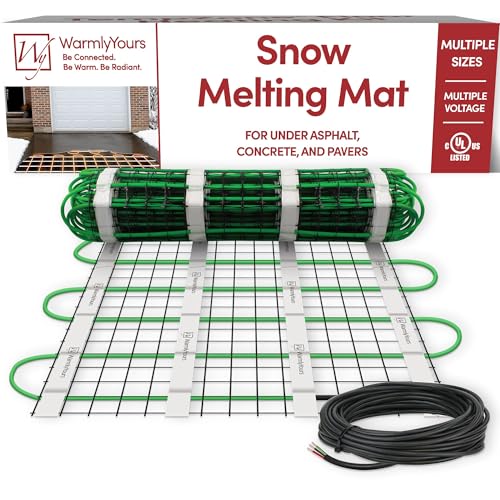
The WarmlyYours mat is embedded for outdoor use under asphalt, concrete, or pavers, offering reliable snow and ice removal without shoveling. It’s CSA certified and uses a twin-conductor heating cable designed for winter conditions and high-traffic areas. Best for embedded, durable installations where a long-term, invisible heat source is preferred. Limitations include the need for proper planning during installation to ensure even heat distribution.
- Best for embedded, long-term installations
- Caution: Requires careful installation planning for full effectiveness
4 Pcs Heated Snow Melting Mats (10×30” Each)

This set includes four 10×30-inch mats with a 6-foot power cord per unit and a 45-inch connection cable. The mats are designed for easy layout customization and support independent use or combined coverage up to 1500 W. They are constructed from durable rubber with anti-slip properties and a maximum heating temperature up to 149°F, functioning in sub-zero conditions. Best for modular, DIY installations where you want flexible coverage across a walkway or steps.
- Best for modular, customizable layouts
- Caution: Power management becomes important when combining mats
Buying Guide: Key Purchase Considerations
Consider the following factors when selecting heated snow mats for driveways and entrances.
- Coverage area: Measure your driveway or walkway to determine how many mats are needed for full coverage or targeted deicing.
- Power requirements: Check voltage (commonly 120V or 240V) and required Circuit capacity. Larger systems may need professional electrical planning.
- Installation: Decide between embedded/under-surface installations or surface-mounted mats. Embedded options are discreet but require more planning.
- Activation method: Sensor-based activation helps conserve energy. Ensure the sensors respond to moisture and temperature appropriate to your environment.
- Durability and weather resistance: Look for corrosion-resistant materials and robust heating elements for winter conditions and outdoor exposure.
- Maintenance: Consider ease of cleaning, durability of connection cables, and whether mats are designed for seasonal removal or year-round exposure.
- Energy efficiency: Compare wattage per square foot and overall energy use relative to the area being heated.
- Safety features: Anti-slip surfaces, CSA/ETL certification, and thermal protection help prevent accidents on icy surfaces.
Frequently Asked Questions
- What size heated mat is best for a standard driveway?
Answer: For a typical single-car driveway, a 30” x 60” mat covers a wide path, while larger systems (300 Sqft) are better for longer driveways or multiple entry points. - Do heated snow mats require professional electrical installation?
Answer: Some systems are plug-and-play, while larger or embedded installations may require electrical planning or professional help, especially for 240V systems. - How fast do these mats melt snow?
Answer: Many mats melt snow at about 2 inches per hour, depending on ambient temperature, moisture, and surface material. - Are heated mats safe to leave outdoors year-round?
Answer: Yes, many are designed for all-season outdoor use, with corrosion-resistant construction, but check the product’s warranty and installation guidelines. - Can I combine multiple mats to cover a larger area?
Answer: Yes, several setups support linking multiple mats, but ensure your power supply and heat management can handle the total load. - Which option is best for retrofit installations under concrete?
Answer: Embedded options like the WarmlyYours mat are well-suited for under concrete, asphalt, or pavers, offering discreet integration.