Best bicycle racks for schools provide a safe, organized, and scalable way to store student bikes, staff bikes, or equipment bikes. These selections emphasize stability, rust resistance, and universal compatibility with common wheel sizes. This guide highlights five top options that suit school lots, PE departments, after-school programs, and campus bike fleets. Each pick is designed to handle high-traffic use while keeping handlebars and wheels neatly separated to prevent damage. The buyer intent focuses on outdoor and indoor school environments with varying bike counts and space constraints.
Summary table of chosen products:
- Product: Retrospec Commercial Grid Bike Rack – 5 Bike / Single Sided
- Best for: Small school bike racks with limited floor space
- Key benefit: Strong steel, weather-resistant coating
- Product: GarveeLife 10 Bike Rack – Double Sided
- Best for: Busy school bike lots needing high capacity
- Key benefit: Weighted base, no drilling required
- Product: Retrospec Commercial Grid Bike Rack – 10 Bike / Single Sided
- Best for: Large school fleets needing organized storage
- Key benefit: 100% steel with rust-resistant coating
- Product: Simple Houseware 5-Bike Floor Storage Rack
- Best for: Budget-conscious schools; easy setup
- Key benefit: Adjustable, 5-bike capacity, sturdy steel
- Product: Sttoraboks Vertical Bike Stand
- Best for: Space-constrained classrooms or garages
- Key benefit: Freestanding, adjustable height, no drilling
Retrospec Commercial Grid Bike Rack — 5 Bike
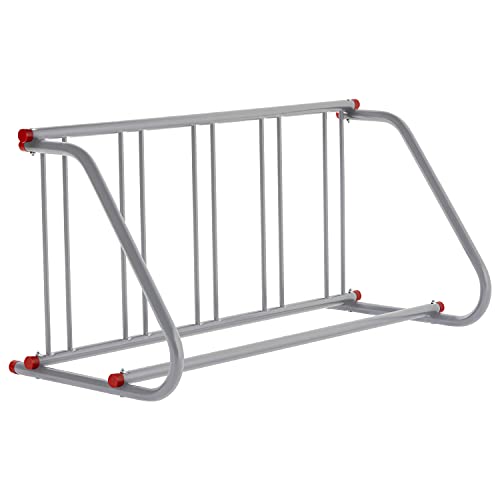
Best for: Schools needing a compact, single-sided rack to fit along walls or hallways. This unit uses heavy-duty steel with reinforced cross bars for stability, ideal for daily student use and PE equipment cycles. The powder-coated finish resists rust and weather, suitable for outdoor or sheltered exterior spaces.
Why chosen: It combines universal wheel compatibility (12″–29″, tires up to 3.0″ wide) with a durable, weather-resilient build. The single-sided design helps conserve space while still providing orderly bike parking. A potential limitation is that larger or non-standard bikes may require an alternative configuration if space is tight.
GarveeLife 10 Bike Rack — Double Sided

Best for: Schools with high bike turnover or large after-school programs. The double-sided design accommodates up to 10 bikes, keeping handlebars separated and wheels secure. It’s particularly effective for crowded bike lots where space efficiency is critical.
Why chosen: A weighted base and low-center design prevent shifting on pavement or slick floors. The galvanized steel with powder-coated finish resists weather exposure, making it a robust option for outdoor or semi-exposed school environments. Limitation: It requires ample floor space to realize its full capacity.
Retrospec Commercial Grid Bike Rack — 10 Bike

Best for: Large schools or campuses with extensive bike fleets wanting centralized storage. This 10-bike rack uses premium 100% steel with rust-resistant powder coating for year-round reliability and modular sizing to accommodate 12″–29″ wheels up to 3.0″ tires.
Why chosen: The design emphasizes stability and separation between bikes to prevent overcrowding. Anchors are sold separately, making it adaptable to existing structures. Caution: Installation anchors are required for optimal performance in some floor types.
Simple Houseware 5-Bike Floor Storage Rack

Best for: Budget-conscious schools seeking a straightforward, adjustable storage solution for multiple bike types. The rack fits wheel sizes from 12″ to 26″ with a maximum tire width of 2.5″, making it ideal for standard student bikes and smaller adult bikes.
Why chosen: Five vertical sections with adjustable orientations help prevent handlebar jams and wheel interference. Steel construction adds stability, though it’s not compatible with oversized 29″ mountain bikes or fat tires, which is important for fleets with diverse bike models.
Sttoraboks Vertical Bike Stand

Best for: Classrooms or small storage rooms needing a freestanding, movable rack that doesn’t require wall mounting. This vertical stand accommodates wheel widths up to 4″ and bikes up to 29″, with adjustable height for different bike types.
Why chosen: The 360° lockable wheels allow easy repositioning, helpful for changing layout or reconfiguring bike lots between sessions. A potential limitation is that it may not fit bikes with fenders or baskets, requiring a different parking solution for those bikes.
Buying Guide
- Capacity vs. footprint: Match rack capacity to peak bike counts. Wall-mounted, single-sided units save floor space, while double-sided and freestanding models boost capacity without shifting floorspace.
- Wheel and tire compatibility: Confirm wheel size range (e.g., 12″–29″) and tire width (e.g., up to 3.0″) to fit your fleet, including kids’ bikes and school bicycles.
- Material and finish: Look for rust-resistant powder coatings and steel construction for outdoor use in all seasons typical of school campuses.
- Stability and safety: Weighted bases, low centers of gravity, and secure wheel wells reduce tipping and bike-to-bike contact—critical in busy areas.
- Installation considerations: Some racks require anchors or drilling; others are freestanding. Consider whether the space allows anchors or if a portable unit is preferable.
- Maintenance: Choose designs with simple maintenance routes and materials that resist weathering to minimize long-term upkeep liabilities.
FAQ
- What size bike racks are suitable for a school parking lot? Typical school fleets use racks supporting 12″–29″ wheel sizes with tires up to 3.0″ wide. Larger capacities (5–10 bikes) are ideal for athletic programs and busier campuses.
- Are freestanding racks safer than wall-mounted ones? Freestanding racks avoid wall mounting, reducing wall damage and enabling flexible placement, though they may require more floor space and a stable base.
- Can these racks be used outdoors? Yes, if they have weather-resistant coating and rust-resistant steel. Outdoor use requires attention to sun and rain exposure for longevity.
- Do racks require assembly? Most units are designed for quick setup. Some require tools or anchors, while others are tool-free or weigh-based stability solutions.
- How do I choose between single-sided and double-sided racks? Single-sided racks save wall or aisle space; double-sided racks maximize capacity in the same footprint, useful in high-traffic areas.
- What maintenance is needed? Periodic cleaning and inspection for rust or bent components helps prevent failures. Reapply protective coatings if exposed to harsh weather.